Nov 05-2025
A Vegetable Bundling “Master”: Eco-friendly and Easy-to-Use Vegetable Twist Tie
READ MORE >

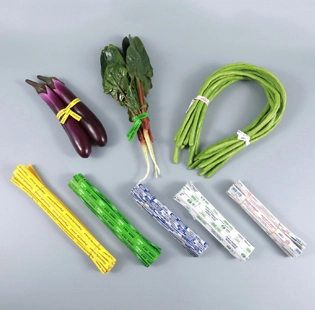
Produce ties are used to hold groups of produce together, but the same produce tie may not suit every bundle. Differences in bundle dimensions, bundle shape, conditions at the tying point, the number of items in each bundle, and how the bundle needs to be held can all affect whether a particular produce tie works in practice.
This article does not cover what a produce tie is or discuss food preservation and packaging solutions. Instead, it addresses a more specific question: once you have decided to use a produce tie for bundling, how do you judge whether a given tie is suitable for the actual produce bundle you need to tie?

The first practical factor to check is the size of the finished bundle. What matters is not the size of an individual vegetable, but the dimensions of the bundle after the produce has been gathered together:
The circumference of the bundle at the tying position
The number of items in each bundle
The actual volume of the arranged produce
Size variation between different product specifications
Circumference is usually more directly relevant than diameter when checking whether a tie can wrap around the bundle. For irregular bundles, a single diameter measurement may not accurately describe the tying position.
A tie that works for a small, compact bundle may not provide enough usable length for a larger or less uniform bundle. Before looking at any tie specification, confirm the typical finished bundle size and how much it varies between batches.
The overall shape of the produce bundle affects how consistently a tie can be applied. Bundles generally fall into two broad categories:
Compact and relatively uniform bundles — where items are arranged consistently and the tying position is similar each time.
Irregular or variable bundles — where individual items vary in size, stems or product ends create an uneven overall shape, or bundle dimensions change between batches.
The more irregular the bundle shape, the more important it is to check whether the tie has enough usable length for the actual tying operation and whether the fastening position can be kept consistent. A tie that works on a neat, uniform bundle may behave differently on an uneven one.
The surface at the tying point is a separate practical factor. Consider what the tie will actually contact at the point where it holds the bundle:
Whether the produce gathers easily at the tying position
Whether thickness varies significantly at that point
Whether stems or product ends create an uneven local surface
Whether the bundle tends to shift after tying
The tie should be evaluated at the actual point where it will hold the bundle, not just against a catalog dimension. If the produce tends to move or change position after tying, check whether the bundle remains in the intended arrangement using actual samples rather than relying on product specifications alone.
Before evaluating a specific produce tie, define what the tie actually needs to do in use:
Is it simply gathering the produce into one bundle?
Does the arrangement need to stay in place during normal handling and transport?
Will the bundle need to be adjusted or opened and re-tied?
Does the tying position need to remain consistent?
The required holding function should be defined before evaluating the tie itself. There is no universal rule that a tighter hold is always better — over-tightening may not suit certain products. The right level of hold depends on the specific bundle and how it will be handled.
With the bundle size, shape, surface conditions, and holding requirements defined, check whether the specifications of the selected produce tie are suitable for the actual bundle.
Available tie length
Whether the tie can wrap around the actual bundle
Whether enough usable length remains for normal twisting or fastening after wrapping
Pre-cut or continuous roll format
Whether the selected format fits the bundling workflow
A simple check is to wrap the tie around the actual bundle at the intended tying position and confirm that sufficient usable length remains to complete normal twisting or fastening. No fixed length formula is assumed here; the check should be based on the real bundle.
Product dimensions and supply format are separate questions. A particular length may suit the bundle, but whether a pre-cut or continuous roll format is more suitable still needs to be confirmed against how the operation actually works.
Sample testing is the most reliable way to confirm suitability. A simple verification process is:
Prepare a representative produce bundle.
Apply the tie at the intended tying position.
Check whether the tie can be fastened with sufficient usable length.
Handle the bundle as it would be handled during normal bundling or movement.
Check whether the produce remains in the intended bundled arrangement after normal handling.
Repeat the test with different bundle sizes if product dimensions vary.
Sample testing is especially useful when bundle size or product shape varies. It is not a certification test or a performance guarantee — it is a practical check that the selected tie suits the actual bundle under the intended handling conditions.
A concise checklist before making a selection:
What is the typical circumference of the finished bundle at the tying position?
How much does bundle size vary?
Is the tying point regular or uneven?
How does the bundle need to be held during handling?
What tie length is required for the actual bundle?
Is a pre-cut or continuous format more suitable for the operation?
Has the tie been tested with representative samples?
These questions confirm product-to-bundle suitability only. Purchasing details such as MOQ, printing, and order terms are a separate matter.
To check whether a produce tie fits a produce bundle, start with the actual bundle: confirm its size at the tying position and whether its shape is consistent. Then check the tie length and format against the actual tying point, making sure enough usable length remains for normal twisting or fastening. Finally, verify the selection with representative samples under the intended handling conditions.
That practical sequence — confirm the actual bundle, check the tie at the tying position, and test with representative samples — is more reliable than selecting a tie by product name or a single dimension alone.
If you wish to purchase relevant products, please contact us.